

Support
How Long Do Loader Tires Last? Wear Factors, Inspection and Cost per Hour

Loader tires represent one of the highest recurring operating expenses for heavy equipment fleets, directly impacting project margins and machine uptime. Unpredictable tire wear, premature failure, and reactive replacement strategies lead to inflated maintenance budgets, unexpected downtime, and compromised machine efficiency. Moving from a reactive purchasing model to a proactive, data-driven approach requires understanding baseline lifespans, standardizing inspection protocols, and evaluating procurement strictly through the lens of Cost Per Hour (CPH). By implementing a structured loader tire maintenance and selection guide, fleet managers can significantly extend operational life and reduce long-term expenses. This guide explores baseline lifespan expectations, primary wear factors, and actionable strategies to maximize your investment in every loader tire.
Baseline Variance: Loader tire lifespans vary drastically by machine size and application, ranging from 400–1,500 hours for skid steers to 4,000–10,000 hours for heavy wheel loaders.
The 80% Threshold: Operating a loader tire past 80% to 85% tread wear exponentially increases the risk of flats, decreases fuel efficiency, and strains the machine's drivetrain.
Surface and Application Dictate Selection: Hard surfaces (concrete, asphalt) and severe applications (demolition, scrap) require specific tread depths and solid/foam-filled configurations to prevent premature degradation.
CPH Over Initial Price: The true value of a loader tire is measured by dividing the total acquisition and maintenance cost by the total hours of operational life, making upfront price a secondary metric.
Baseline Lifespan Expectations for the Modern Loader Tire
Establishing accurate baseline hours based on machine class sets realistic procurement budgets and maintenance schedules. You cannot manage what you do not measure. Understanding these baselines helps identify when a tire underperforms due to site conditions, incorrect specification, or operational errors. Fleet managers need hard data to push back against premature wear and justify procurement choices to upper management.
Skid Steer vs. Wheel Loader Averages
The expected lifespan for skid steer tires typically falls between 800 and 1,000 hours under standard dirt or landscaping conditions. However, this number plummets to 400–600 hours in severe demolition applications where rebar, jagged concrete, and scrap metal tear at the rubber. Skid steers counter-rotate to turn, which drags the rubber across the ground. This scrubbing action acts like sandpaper on the tread blocks. When operating on abrasive surfaces like brushed concrete or asphalt, the wear rate accelerates rapidly.
Mid-sized loaders generally achieve 2,000–5,000 hours. These machines handle municipal work, aggregate loading, and general construction. Heavy wheel loaders operating in quarries or large-scale mining operations can reach 4,000–10,000 hours. Machine weight, articulation angles, and operational speed significantly alter wear rates across these categories. A 100,000-pound loader carrying a full bucket of wet sand puts immense pressure on the front axle, compressing the tire and generating massive internal heat. Heat breaks down rubber compounds, leading to faster degradation.
Machine Class | Standard Application Hours | Severe Application Hours | Primary Wear Mechanism |
|---|---|---|---|
Skid Steer | 800 - 1,000 | 400 - 600 | Counter-rotation scrubbing |
Mid-Size Loader | 2,000 - 5,000 | 1,500 - 2,500 | Load compression and roading |
Heavy Wheel Loader | 6,000 - 10,000 | 4,000 - 6,000 | Internal heat generation and rock cuts |
Pneumatic vs. Solid and Foam-Filled Configurations
Pneumatic tires offer excellent performance with better operator comfort. The air chamber acts as a shock absorber, reducing operator fatigue and protecting the machine's suspension components. However, they are limited to 500–1,500 hours in high-hazard environments due to puncture risks. A single piece of scrap metal can destroy a brand-new pneumatic tire, instantly ruining the investment.
Solid and foam-filled tires present a higher upfront acquisition cost but are capable of 1,500–3,000+ hours in severe applications. By eliminating flat risks entirely, they keep machines running in transfer stations, scrap yards, and demolition sites. Foam filling replaces the air with a dense polyurethane liquid that cures into a solid core. Solid tires are molded entirely from rubber compounds. Both options add significant weight to the machine, which can actually improve stability when lifting heavy loads, though it may increase drivetrain wear over thousands of hours.
Primary Wear Factors Accelerating Tire Degradation
Identifying the environmental and operational variables that cause a loader tire to fail before reaching its theoretical maximum lifespan allows you to intervene early. Wear is inevitable, but accelerated, uneven wear is a symptom of a correctable problem.
Surface Conditions and Abrasiveness
High-friction surfaces like concrete and asphalt accelerate wear compared to yielding surfaces such as dirt, sand, or mud. When a loader turns on dirt, the ground gives way. When it turns on concrete, the rubber gives way. Abrasive surfaces accelerate tread scrubbing, particularly during tight turns or aggressive maneuvering. Extreme surface degradation might prompt a fleet to evaluate tracks versus tires for specific sites. If a machine spends 90% of its life on a paved recycling center floor, a specialized hard-surface tread compound is mandatory to prevent the lugs from tearing off.
Application Severity and Load Stress
Wear patterns differ vastly between standard stockpiling and high-impact applications like demolition or quarry work. Continuous heavy bucket loads increase front-axle tire compression. As the loader drives into a pile of dense material, the weight transfers forward. The front tires flatten out, increasing the contact patch but also generating extreme heat in the sidewall and shoulder. This explains exactly why front tires consistently wear out faster than rear tires on loader equipment. The rear tires act as a counterweight, experiencing far less compression and scrubbing during the loading cycle.
Operator Behavior and Machine Maintenance
Operators hold the key to tire longevity. Aggressive braking, excessive spinning into piles, and high-speed roading rapidly degrade rubber compounds. When an operator spins the wheels while pushing into a gravel pile, the tires act like grinding wheels, shaving off millimeters of rubber in seconds. High-speed roading between job sites builds up internal heat that the tire cannot dissipate, leading to ply separation.
Maintaining optimal air pressure plays a critical role in preventing premature failure. Fleet managers must enforce strict pressure checks.
Under-inflation causes excessive sidewall flex, generating heat that destroys the tire from the inside out.
Over-inflation reduces the contact patch, accelerating center tread wear and making the tire highly susceptible to impact breaks.
Uneven pressure across an axle forces the machine's differential to work harder, leading to mechanical wear.
Seasonal temperature changes naturally alter tire pressure, requiring adjustments in summer and winter.
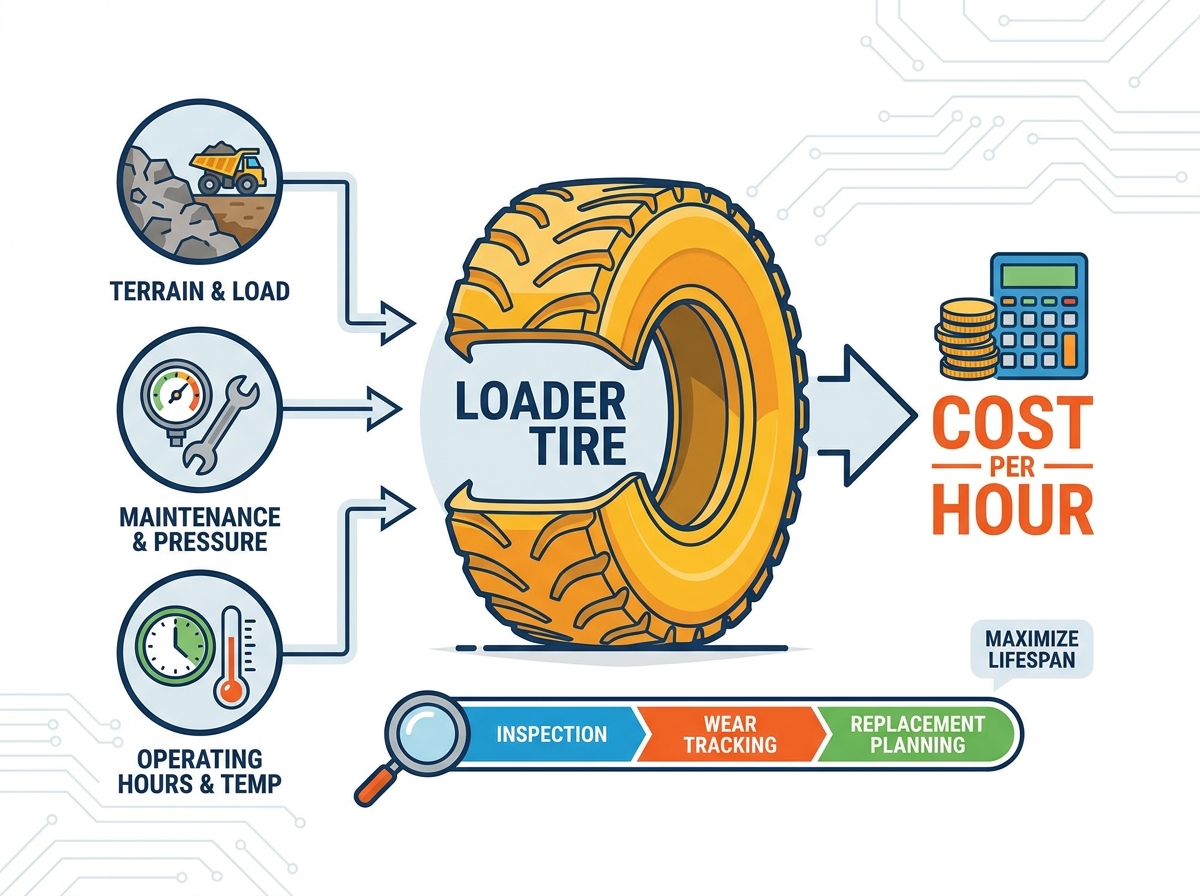
Developing a Loader Tire Maintenance and Selection Guide
Creating standardized operational frameworks extends tire life and ensures you select the correct replacements. Guesswork leads to wasted budget. A systematic approach to inspection and selection guarantees that every machine rolls on the right rubber for the job.
Routine Inspection Protocols and the 80% Rule
Daily and weekly inspection checklists must identify chunking, sidewall cuts, radial cracking, and uneven wear patterns. Operators should walk around the machine before turning the key. They need to look for rocks wedged between duals, deep lacerations exposing the steel belts, and missing tread lugs. The 80% to 85% tread wear threshold marks the point where traction drops and flat risk spikes. Scheduling replacement before this threshold prevents operational efficiency from suffering. Running a tire until it is completely bald forces the machine to burn more fuel to push into piles, as the tires slip instead of gripping.
Aligning Tread Patterns with Site Requirements (L-Classifications)
Industry-standard earthmover tire classifications dictate application suitability. You must match the L-rating to the ground conditions.
Classification | Tread Depth | Best Application | Characteristics |
|---|---|---|---|
L2 | Standard | Sand, dirt, general construction | Maximum traction in soft conditions, self-cleaning voids. |
L3 | Standard | Rock, gravel, general loading | Good balance of traction and rock resistance. |
L4 | Deep (150%) | Quarry, abrasive surfaces | Thicker tread for longer wear life, heavier casing. |
L5 | Extra Deep (250%) | Demolition, severe rock, scrap | Massive lugs, highly resistant to cutting and chunking. |
An L5 tire suits severe rock or demolition environments, while L2 or L3 designs handle general dirt work. Putting an L5 tire on a machine that only works in soft mud is a mistake; the heavy lugs will sink, and the tight void ratio will pack with mud, turning the tire into a slick cylinder. Conversely, running an L2 tire in a scrap yard guarantees a blowout within a week.
Retreading Viability and Casing Management
Retreading wheel loader tires offers economic viability to extend lifespan. Premium casings are built to outlast their original tread. Casing inspection criteria require strict evaluation to ensure a tire remains a safe candidate for retreading. Technicians use shearography and visual inspections to check for structural integrity, rust in the steel belts, and the absence of deep casing damage. If a casing passes inspection, applying a new tread can provide a second life at a fraction of the cost of a new tire. However, poor maintenance, such as running under-inflated, will ruin the casing and eliminate the retread option.
Calculating Cost Per Hour (CPH) for Fleet Procurement
Shifting procurement focus from initial capital expenditure to long-term operational efficiency ensures better financial outcomes. Buying the cheapest tire often results in the highest operating cost. Fleet managers must track data meticulously to prove the value of premium rubber.
The CPH Formula and Long-Term Expense Tracking
The standard CPH calculation is straightforward: (Initial Tire Cost + Maintenance + Repair Costs) / Total Operating Hours. A premium tire with a higher upfront cost often yields a lower CPH than a budget alternative that fails prematurely. For example, if a budget tire lasts 1,000 hours but requires frequent puncture repairs, the downtime and repair bills inflate the CPH. A premium tire might cost twice as much upfront but last 3,000 hours with zero downtime. The math heavily favors the premium option. Tracking this requires logging every hour the machine runs and every maintenance event associated with the tires.
Partnering with a Durable Loader and Earthmover Tire Manufacturer
Selecting a manufacturing partner requires evaluating compound engineering, warranty terms, and technical field support. A durable loader and earthmover tire manufacturer provides site audits and application-specific compound recommendations to guarantee lower CPH. They send engineers to your site to measure tread wear, analyze failed tires, and recommend specific tread patterns. They understand that a tire working in a hot slag pit requires a completely different heat-resistant compound than a tire working in a freezing logging camp. Building a relationship with a manufacturer ensures you get technical backing when failures occur.
Implementation Risks: When to Replace vs. Run to Failure
Addressing the hidden costs of delaying tire replacement helps squeeze out extra hours safely without risking catastrophic failure. Pushing a tire too far looks good on a spreadsheet for one month but destroys the maintenance budget the next.
The Hidden Costs of Delayed Replacement
Mechanical risks include mismatched tire diameters or bald tires causing drivetrain wind-up, differential strain, and transmission failure. When you run a bald tire on the same axle as a newer tire, the smaller diameter of the bald tire forces it to rotate faster than the larger tire. The machine's differential has to constantly compensate for this speed difference, generating extreme heat and wearing out the gears. Secondary costs manifest as increased fuel consumption due to wheel slip and decreased bucket fill factors. If the machine cannot gain traction, the operator spends more time spinning the wheels to fill the bucket, burning diesel and wasting labor hours.
Phased Fleet Replacement Strategies
Replacing tires in pairs or sets maintains machine balance. Never mix radial and bias-ply tires on the same machine, and always ensure tires on the same axle have matching outside diameters. Inventory management strategies ensure replacement tires are on hand before the 80% wear threshold is breached, minimizing costly machine downtime. Supply chain delays can leave a machine parked for weeks if you wait until a tire blows out to order a replacement. Keep a rotating stock of mounted spares ready to deploy.
Maximizing loader tire lifespan is not about avoiding wear, but managing it predictably through strict application matching and pressure maintenance. Fleet managers must select tires based on a rigorous assessment of surface conditions, L-classification requirements, and historical CPH data, rather than initial purchase price.
Audit the current fleet for tires approaching the 80% wear mark to prevent unexpected downtime.
Calculate the baseline CPH of the outgoing set using historical maintenance logs and hour meters.
Consult with a specialized manufacturer to specify the optimal tread and compound for the next procurement cycle.
Implement a weekly pressure check schedule using calibrated gauges to protect casing integrity.
FAQ
Q: How many hours should a wheel loader tire last?
A: Wheel loader tires typically last between 4,000 and 10,000 hours, depending on machine weight, application severity, and maintenance practices. Hard surfaces and heavy loads reduce this lifespan, while proper inflation and smooth operation extend it.
Q: How many hours do skid steer tires typically last?
A: Skid steer tires generally last 800 to 1,000 hours under standard conditions, but lifespan drops to 400–600 hours in severe applications like demolition due to aggressive counter-rotation and abrasive debris.
Q: Why do the front tires on a loader wear out faster than the rear?
A: Front tires wear faster due to continuous heavy bucket loads, which increase compression, heat generation, and scrubbing during loading cycles. The weight transfer heavily burdens the front axle.
Q: At what tread depth should loader tires be replaced?
A: Loader tires should be replaced when they reach 80% to 85% tread wear to avoid decreased traction, higher flat risks, and drivetrain strain caused by wheel slip and mismatched diameters.
Q: Are solid skid steer tires worth the extra cost?
A: Yes, in severe applications like scrap yards and demolition sites. They eliminate flat risks entirely and can last 1,500–3,000+ hours, significantly lowering the overall Cost Per Hour despite the higher initial investment.
Q: How does tire pressure affect loader tire lifespan?
A: Incorrect pressure accelerates wear. Under-inflation causes damaging sidewall flex and heat buildup, while over-inflation leads to rapid center tread wear and increases vulnerability to impact breaks.
Q: What is the difference between L3, L4, and L5 loader tires?
A: L3 tires are standard rock tires for general use. L4 tires offer 150% deeper tread for extended wear in abrasive conditions, and L5 tires provide 250% extra-deep tread for severe rock and demolition environments.


