

Support
How to Choose an Application-Specific Wheel Loader Tire

Selecting the wrong tire destroys profitability on any job site. Premature tread wear and catastrophic failures halt operations immediately, leaving operators stranded and production schedules ruined. Increased fuel consumption drains budgets over time, while drivetrain strain leads to massive repair bills that could have been avoided. Wheel loaders work in highly variable environments. Quarries, waste transfer stations, and snow removal sites demand specific traction profiles and structural integrity. A generalized approach to tire procurement fails every time. It creates severe safety hazards and inflates hourly operating costs beyond acceptable margins.
We need a technical framework for evaluating tire specifications. Matching tread and compound to exact job site demands is mandatory for heavy equipment management. Balancing upfront costs against long-term performance ensures operational efficiency and keeps machines moving. This guide breaks down the selection process from the ground up. You will learn how to analyze surface conditions, decode industry classifications, and match the right tire structure to your specific machine class without relying on guesswork.
Tire selection must begin with a rigorous application analysis, prioritizing surface conditions, heat generation, and puncture risk over brand preference.
Mastery of TRA (Tire and Rim Association) codes is non-negotiable for matching tread depth and design to specific loader tasks (e.g., L-3 for general purpose vs. L-5 for severe rock).
Partnering with a specialized wheel loader tire supplier mitigates supply chain risks, ensures exact rim compatibility, and provides critical post-sale technical support.
Defining Success Criteria: Analyzing Jobsite Demands
Every tire selection starts with the ground you drive on. Evaluate your primary operating surface carefully before looking at any specifications. Highly abrasive surfaces like granite quarries and scrap yards destroy standard rubber quickly. These environments require maximum cut resistance, thick sidewalls, and specialized compounds designed to reject sharp impacts. Soft, muddy, or loose dirt environments demand aggressive traction to prevent wheel spin. Tires in soft conditions need high void-to-lug ratios to clear debris naturally as the wheel rotates.
Load capacity and speed dictate heat generation inside the casing. Ton-Mile-Per-Hour (TMPH) or Ton-Kilometer-Per-Hour (TKPH) calculations measure this exact stress. Cycle lengths and travel speeds determine how hot a tire gets during continuous operation. Excessive heat causes internal separation, ply degradation, and eventual blowout. High-speed, long-cycle operations require tires engineered for rapid heat dissipation, often utilizing radial construction and specialized cooling channels in the tread design.
Operating environment temperatures alter rubber compound performance drastically. Extreme heat accelerates wear and degrades structural integrity over long shifts. Long, continuous cycles compound this thermal stress, requiring operators to monitor internal temperatures closely. Cold weather operations present the opposite challenge. Snow removal and winter applications require flexible compounds that maintain grip. Stiff rubber loses traction on ice, chunks easily, and cracks under freezing conditions, rendering standard summer tires useless in northern climates.
Understanding the specific gravity of the material you are moving also plays a role. Loading dense iron ore places a completely different dynamic load on the front axle compared to loading wood chips or municipal waste. The breakout force required to penetrate a pile of blasted rock transfers immense torque through the tire bead. If the tire is not rated for that specific application, the bead will slip on the rim, causing immediate air loss and potential rim damage.
Site maintenance cannot be ignored during this evaluation. A well-maintained haul road allows for faster travel speeds and reduces the risk of impact breaks. A poorly maintained site with deep ruts, spilled rock, and standing water requires a much more robust tire to survive. You must assess the reality of your site conditions, not the ideal scenario, when selecting your rubber.
Loader Tire Types and Applications: Core Categories
Understanding loader tire types and applications prevents costly mismatches in the field. The structural foundation of the tire determines its behavior under heavy load and high torque.
Radial vs. Bias Ply Pneumatic Tires
Radial tires feature steel cords running perpendicular to the bead. This construction allows the sidewall and tread to function independently, creating a flexible casing that absorbs ground irregularities. Radials provide a larger, flatter footprint and better traction. They generate significantly less heat during operation because the internal friction is lower. Ride comfort improves, reducing operator fatigue over a ten-hour shift. Radials dominate high-speed, long-cycle applications where heat buildup is the primary enemy.
Bias ply tires use nylon cords placed diagonally across the casing, overlapping in multiple layers. The crisscross pattern creates an exceptionally stiff, rigid structure. Thicker sidewalls offer superior stability under heavy bucket loads, preventing the machine from swaying when lifting materials to full height. Sidewall cut resistance is excellent because of the multiple nylon plies. Bias ply tires excel in low-speed, high-debris environments where puncture risk is high and travel distances are short.
Solid Loader Tires
Solid tires eliminate air entirely, replacing the pneumatic cavity with solid rubber layers. Waste management, recycling, and scrap metal facilities rely on them heavily to survive fields of jagged metal and glass. They offer maximum puncture resistance and zero downtime from flats. However, trade-offs exist and must be managed. Solid tires increase machine weight significantly, altering the center of gravity. Ride quality drops drastically, leading to potential operator fatigue and back pain. Drivetrain components absorb more shock, requiring more frequent inspections of axles and differentials.
To mitigate the harsh ride, many solid tires feature aperture holes—engineered voids in the sidewall that allow the rubber to flex slightly under load. While this helps, it does not replicate the pneumatic ride. Pressing solid tires onto rims also requires specialized heavy-duty hydraulic presses, meaning you cannot simply swap a tire in the dirt with standard hand tools.
Airless/Non-Pneumatic Loader Tires
Emerging airless technologies bridge the gap between solid and pneumatic options. They utilize engineered polyurethane spokes or complex rubber webs to support the load. They offer zero-flat reliability with better shock absorption than solid rubber. General Purpose (GP) machines operating in unpredictable debris fields benefit most from this technology. Current limitations restrict their use in high-speed or extremely heavy-load applications due to heat buildup in the spokes. They provide a functional middle ground for specific utility tasks where flats are common but machine speeds remain low.
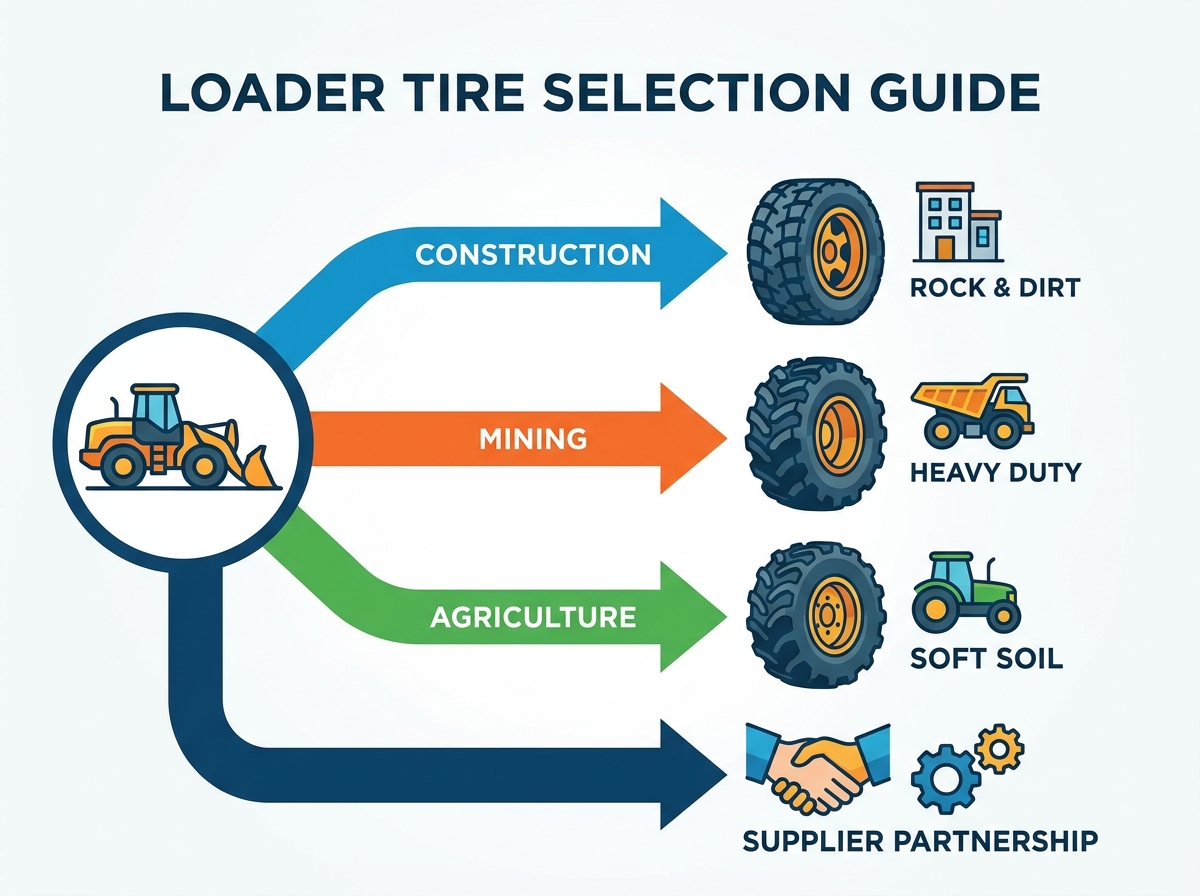
Decoding TRA Codes and Tread Patterns
The Tire and Rim Association (TRA) standardizes classifications across the industry. Mastery of the L-Series codes simplifies the selection process and ensures you are comparing apples to apples when evaluating different brands.
Understanding the L-Series Classification
The L-series designates tires specifically built for loaders and dozers. The number following the 'L' indicates the tread depth and intended application. Choosing the wrong L-code guarantees premature failure.
L-2 (Traction): Standard tread depth designed for soft conditions like sand, dirt, and mud. Features an aggressive directional pattern.
L-3 (Rock): Standard tread depth for general construction and moderate rock handling. The most common factory-fit tire.
L-4 (Rock Deep Tread): Features 150% tread depth compared to L-3. Built for severe conditions, abrasive surfaces, and extended wear life.
L-5 (Rock Extra Deep Tread): Features 250% tread depth. Designed for extreme abrasion, maximum cut resistance, and harsh environments like scrap yards and deep quarries.
Tread Design Selection
Tread designs map directly to operational outcomes. Directional patterns maximize forward traction in loose material, digging in as the machine pushes into a pile. Non-directional patterns allow even wear in machines that reverse frequently, extending the usable life of the rubber. Block patterns provide biting edges for winter and snow clearing, gripping slippery surfaces effectively. Smooth treads deliver maximum ground contact for dry, hard-surface compaction. They also offer extreme tear resistance in scrap yards because there are no lugs for sharp metal to grab and tear off.
Void-to-lug ratios matter immensely. Wide voids ensure self-cleaning properties in muddy or sticky clay environments. If the voids pack with mud, the tire becomes a smooth cylinder, losing all traction. Conversely, tight void ratios put more rubber on the ground, improving wear life on hard, abrasive surfaces like concrete or packed gravel.
Rubber Compounds
Tire manufacturing involves strict chemical trade-offs. You cannot have maximum cut resistance and maximum heat resistance simultaneously. Cut-resistant compounds use specific carbon black mixtures that wear slower in sharp rock but retain internal heat. Heat-resistant compounds dissipate thermal energy efficiently to prevent degradation in long-haul cycles but cut easier on sharp rocks. Specialized winter compounds use silica to remain pliable in freezing temperatures but wear rapidly if used on hot summer pavement. Choose the compound based on your primary operational hazard.
Loader Tire Tread Pattern Comparison | |||
Tread Pattern | Primary Benefit | Ideal Application | Drawback |
|---|---|---|---|
Directional (Lug) | Maximum forward traction | Mud, loose dirt, sand | Uneven wear if reversed often |
Non-Directional (Rock) | Even wear, good stability | Quarries, gravel pits | Less traction in deep mud |
Block Pattern | Multiple biting edges | Snow removal, winter ops | Faster wear on dry concrete |
Smooth (No Lugs) | Maximum tear resistance | Scrap yards, dry compaction | Zero traction in wet/muddy conditions |
Technical Evaluation: Sizing, Compatibility, and Safety
Machine size classifications dictate tire requirements. Operating weight, horsepower, and bucket capacity determine the necessary load index and ply rating. Compact loaders need different structural support than large production loaders moving 10 yards of material per pass.
Matching the tire’s bead seat diameter to the exact rim size is critical. A mismatched loader tire causes rim slip under heavy torque. Air loss follows quickly. Catastrophic failure is inevitable if the bead does not seat perfectly against the rim flange. Always verify the rim width and diameter stamped on the wheel before ordering replacement rubber.
Clearance constraints limit upgrade options. Upgrading to deeper L-5 treads or larger profiles changes the machine's geometry. Check for interference with fenders, steering cylinders, and linkage components at full articulation. Larger tires alter the final drive ratio, effectively changing the gearing of the machine. This modification places additional strain on the drivetrain and hydraulic systems, potentially leading to overheating or premature transmission wear.
Verify axle load ratings and inflation pressures. The selected tire must meet or exceed the manufacturer's axle load ratings. Calculate this under maximum bucket breakout force and full articulation, as weight transfers dramatically when the machine turns. Proper inflation pressure carries the load; the tire simply contains the air. Running a tire underinflated by just 10% reduces its carrying capacity and increases heat generation exponentially.
O-rings and valve stems must be replaced every time a new tire is mounted. Reusing old O-rings guarantees slow leaks. Ensure the lock rings are seated correctly and use a remote inflation cage when airing up a newly mounted multi-piece rim to protect technicians from explosive separation.
Value Trade-offs and Budget Considerations
Navigating the budget tire market requires strict evaluation of structural components. Identify reliable Tier 3 options for low-hour, utility machines that only run a few hours a week. Evaluate casing strength, rubber quality, and manufacturer warranties carefully. High-hour, critical-path production machines demand Tier 1 premium brands. Downtime on a production machine halts the entire operation.
Maintenance extends lifecycle possibilities significantly. Evaluate the structural integrity required for a casing to be retreaded. A strong casing allows multiple lives, maximizing the initial investment. Tire Pressure Monitoring Systems (TPMS) protect the rubber. Real-time pressure data prevents underinflation failures, alerts operators to slow leaks before they become blowouts, and extends tread life by ensuring optimal footprint contact.
Daily walk-around inspections catch minor issues before they destroy the tire. Look for deep cuts exposing cords, uneven wear patterns indicating mechanical misalignment, and rocks wedged between duals or in the tread voids. Removing a sharp rock from a tread void takes ten seconds but saves a ten-thousand-dollar tire from a puncture.
Evaluating and Selecting a Wheel Loader Tire Supplier
Inventory availability prevents crippling downtime. Assess the supplier’s ability to stock application-specific sizes locally. Unexpected failures happen on every job site. Waiting weeks for a replacement container to arrive halts production entirely. A reliable wheel loader tire supplier maintains local inventory for immediate dispatch to your site.
Technical support separates parts vendors from true operational partners. Evaluate their capability to provide field engineering support and site audits. Scrap tire analysis identifies operational issues causing premature wear, such as operators spinning tires into the pile or running incorrect pressures. Transparent, enforceable warranty terms protect against manufacturing defects. Demand clear warranty documentation before purchase and understand exactly what constitutes a warrantable failure versus operational abuse.
A strong supplier will also offer mounting services, pressing capabilities for solid tires, and proper disposal of scrap rubber. They should understand your specific industry, whether it is aggregate production, waste handling, or municipal snow clearing, and recommend products based on field data rather than just reading a catalog.
Conclusion
The optimal tire is a calculated compromise. Traction, durability, and operating costs must balance perfectly for your specific site. Site-specific data dictates this choice entirely. Brand loyalty should never override application requirements. Follow a strict shortlisting logic. Define the application and required TRA code first. Select the structural type next. Verify load, machine size, and rim compatibility. Finally, evaluate supplier reliability and technical support capabilities.
Audit current tire wear patterns across your fleet to identify specific job site hazards and operator habits.
Calculate exact load and speed requirements using TMPH or TKPH formulas based on your longest haul routes.
Initiate a consultation with a qualified supplier to conduct a comprehensive site study and scrap tire analysis.
Install TPMS on high-production machines to monitor pressure and temperature in real-time.
Establish a strict daily inspection routine to catch cuts, embedded rocks, and slow leaks early.
FAQ
Q: What is the difference between L-3 and L-5 loader tires?
A: The primary difference is tread depth and application. L-3 tires have a standard tread depth suited for general construction and moderate rock. L-5 tires feature an extra deep tread (250% of standard) designed for extreme abrasion and maximum cut resistance in harsh environments like scrap yards.
Q: How do I determine the correct loader tire size for my specific machine class?
A: Consult your machine's OEM manual. You must match the tire's load index, ply rating, and bead seat diameter to the loader's operating weight, horsepower, bucket capacity, and exact rim dimensions to ensure safety and prevent drivetrain strain.
Q: Are solid loader tires better than pneumatic tires?
A: They are better for specific applications like waste management where puncture risk is extreme. They offer zero downtime from flats. However, they are heavier, reduce ride quality, and transfer more shock to the machine's drivetrain compared to pneumatic tires.
Q: How long should a wheel loader tire last in a quarry application?
A: Lifespan varies heavily based on site conditions, operator behavior, and tire compound. In severe quarry applications, a properly matched L-4 or L-5 tire might last anywhere from 2,000 to 4,000 hours, provided inflation pressures are strictly maintained.
Q: What causes premature tread wear on loader tires?
A: Incorrect inflation pressure is the leading cause. Other factors include mismatched rubber compounds for the surface, excessive travel speeds generating high heat, aggressive operator braking or spinning, and mechanical misalignment of the machine's axles.
Q: Can I mix different loader tire types or tread depths on the same machine?
A: No. Mixing tire types, tread depths, or outside diameters on the same machine causes severe mechanical issues. It forces the axles to rotate at different speeds, leading to rapid drivetrain wear, differential failure, and unpredictable handling.
Q: Are budget wheel loader tires safe for heavy-duty applications?
A: Budget tires are generally safe for low-hour, utility machines. For high-hour, critical-path production machines in heavy-duty applications, budget tires often lack the casing strength and advanced compounds required, leading to premature failure and costly downtime.


