

Support
L3 vs. L4 Loader Tires: What Is the Difference and Which Should You Choose?

Selecting the correct tread depth for heavy equipment directly dictates machine uptime and overall operational efficiency. In earthmoving and quarry operations, tires represent a massive operating expense for wheel loaders immediately following fuel consumption. Equipment managers constantly face the dilemma of over-specifying versus under-specifying tread depth. Deploying an L3 tire in an environment that demands an L4 leads to rapid tread wear, sidewall punctures, and catastrophic failure. Conversely, mounting an L4 tire when an L3 suffices results in unnecessary capital expenditure and severe heat-related failures during extended tramming. To optimize performance, operators must match the physical characteristics of the loader tire to the specific abrasive and thermal demands of the job site. Evaluating site conditions, haul distances, and driveline tolerances is mandatory to make an evidence-based decision between L3 and L4 configurations.
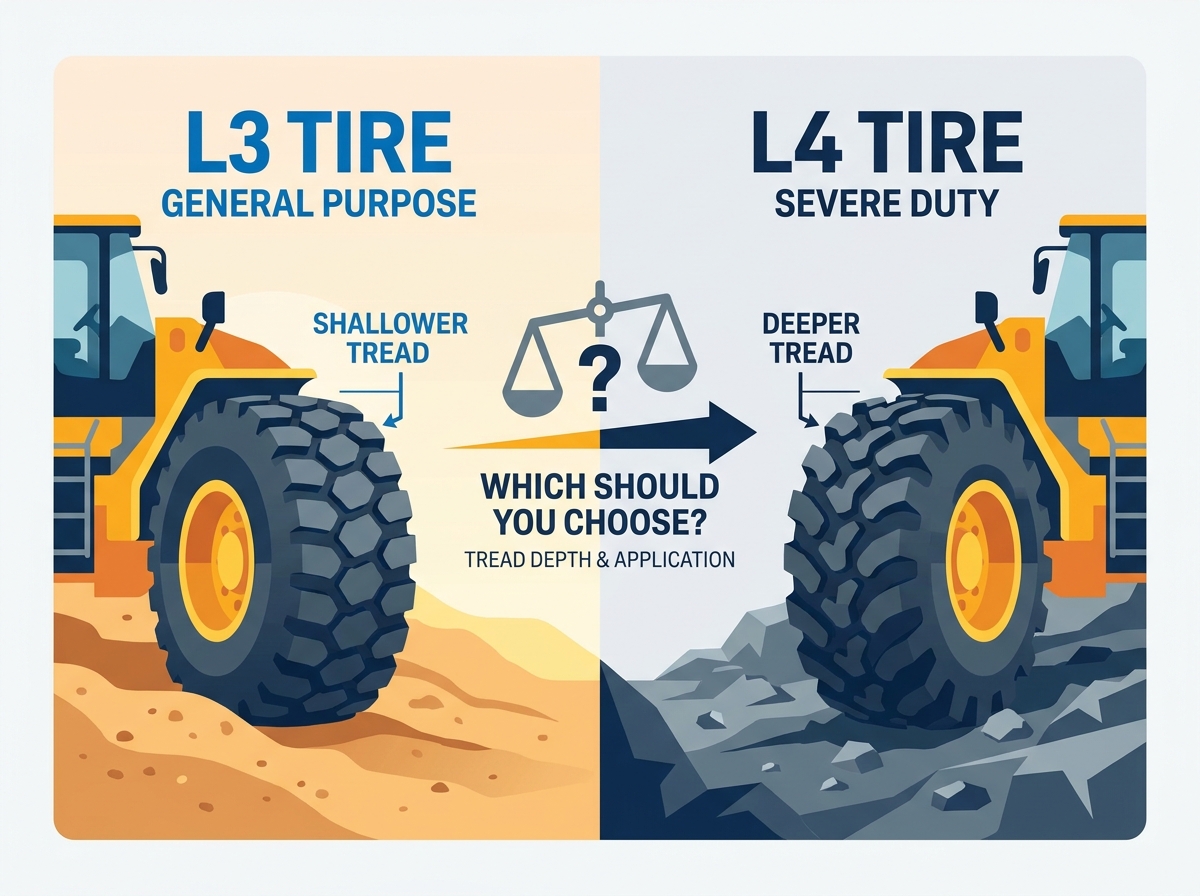
Tread Depth Variance: L4 tires feature a tread depth approximately 150% deeper than their L3 counterparts, offering significantly higher cut and wear resistance.
The Strategic Middle Ground: L4 tires serve as the optimal "sweet spot" for abrasive applications, bridging the gap between the standard cost-efficiency of an L3 and the extreme, heavy-duty protection of an L5.
Thermal Limitations: The thicker rubber mass of an L4 tire retains more heat, making L3 tires the superior choice for operations requiring higher speeds or longer tramming distances.
Driveline Sensitivities: Upgrading from L3 to L4 alters the tire's Outside Diameter (OD), which can impact driveline synchronization if not managed correctly across axles.
The Baseline Mechanics of a Loader Tire
The Tire and Rim Association (TRA) L-Series Classification
The Tire and Rim Association (TRA) establishes standardized classifications for off-the-road (OTR) tires to ensure consistent performance metrics across the industry. The "L" designation stands for Loader/Dozer. Tires in this category are engineered specifically for low-speed, high-torque applications where maximum load capacity and stability are paramount. The numerical suffix following the letter indicates the relative tread depth and the tire's intended resistance to rock damage.
The scale typically ranges from 2 to 5. An L2 offers maximum traction in soft soil but minimal rock protection. An L3 represents the standard baseline tread depth for general earthmoving. An L4 provides a deep tread for rocky conditions, and an L5 delivers an extra-deep tread for extreme, severe-duty environments like underground mining or scrap yards. These classifications scale uniformly across equipment sizes, applying equally to massive wheel loaders in open-pit mines and compact skid steers operating in abrasive recycling facilities. Understanding this baseline is the first step in preventing premature casing failure and maximizing operational hours.
E-Series vs. L-Series Overlap (E3/L3 and E4/L4)
Operators frequently encounter dual-marked tires on specification sheets, such as E3/L3 or E4/L4. This nomenclature indicates that the tire meets the structural requirements for both Earthmover (E) and Loader (L) applications. However, the operational intent behind these two designations differs significantly in practice.
The E-series rating is designed for transport vehicles, such as articulated dump trucks, which travel at higher speeds over longer distances. These tires are engineered to dissipate heat effectively during sustained rolling. The L-series rating focuses on digging, loading, and short-cycle operations where the machine operates at very low speeds but generates massive breakout torque. When a tire carries a dual marking, it offers a versatile casing, but operators must still adhere to the strict speed and load limitations dictated by the specific task at hand. Running an E3/L3 tire at E-series speeds while carrying an L-series payload will inevitably result in thermal degradation.
L3 Loader Tires: Specifications, Strengths, and Limitations
Standard Tread Architecture and Heat Dissipation
The L3 classification establishes the baseline 100% tread depth standard for the industry. This standard tread architecture utilizes a moderate rubber volume, which plays a critical role in thermal management. During continuous operation, heavy equipment tires generate substantial internal heat due to casing deflection and friction against the ground surface.
Because the L3 tire features less physical rubber mass than deeper-tread alternatives, it facilitates superior heat dissipation. The thinner tread blocks allow heat to escape into the surrounding air much faster. This thermal efficiency prevents the internal components of the tire from reaching critical temperatures that cause tread separation or casing degradation during extended work cycles. For operations that require loaders to tram back and forth across a large yard, this cooling capability is non-negotiable.
Ideal Application Environments
L3 tires excel in environments where speed, distance, and flotation take precedence over extreme impact resistance. They are the standard choice for most general construction and earthmoving tasks. When evaluating a site for L3 suitability, look for relatively clean underfoot conditions.
General dirt loading and excavation projects where sharp rocks are minimal.
Operations on soft soil, sand, and loose gravel that require good flotation.
Stockpiling and material transfer in aggregate yards with well-maintained floors.
Load-and-carry applications involving longer haul distances between the pile and the hopper.
In these scenarios, Ton-Mile-Per-Hour (TMPH) or Ton-Kilometer-Per-Hour (TKPH) ratings become critical operational metrics. The L3's ability to shed heat allows wheel loaders to maintain higher average speeds over longer tramming routes without risking thermal failure. This keeps production cycles fast and efficient.
Operational Risks and Vulnerabilities
The primary vulnerability of an L3 tire emerges when it is deployed outside its intended environment. In highly abrasive rock quarries or demolition sites filled with jagged debris, the standard tread depth provides insufficient protection for the underlying casing. The thinner rubber layer simply cannot absorb heavy impacts from sharp objects.
Operators face a high risk of rapid tread wear, chunking, and catastrophic sidewall punctures. When heavy machines spin their wheels on sharp rocks while crowding a pile, the L3 tread can be shredded quickly. Premature tire replacement due to impact damage disrupts production schedules and forces unplanned maintenance downtime, severely impacting site efficiency. Using an L3 in a rock face is a guaranteed way to destroy a new set of tires within a few hundred hours.
L4 Loader Tires: Specifications, Strengths, and Limitations
Deep Tread Architecture and Cut Protection
The defining characteristic of an L4 tire is its deep tread architecture, which measures approximately 150% of the baseline depth found on an L3 tire. This massive increase in rubber volume is specifically engineered to provide a sacrificial layer against severe abrasion and sharp impacts. It acts as a thick shield for the vulnerable casing plies beneath.
Beyond just a thicker tread, L4 tires often feature structural reinforcements in the casing and the tread face. The rubber compounds used in these tires are formulated to resist chunking, tearing, and cutting. The robust lug design minimizes the exposed void areas, ensuring that sharp rocks and debris have fewer opportunities to penetrate the structural belts of the tire. This dense rubber configuration is what allows a loader to aggressively attack a pile of blasted granite without suffering immediate tire failure.
Ideal Application Environments
L4 tires are built for punishing terrain where traction, stability, and puncture resistance heavily outweigh the need for speed. They thrive in harsh industrial and mining environments where the ground is littered with hazards.
Pit and quarry face-loading operations handling blasted rock.
Abrasive construction and infrastructure sites with heavy debris.
Heavy rock handling and aggregate processing facilities.
Recycling facilities, scrap yards, and waste transfer stations.
In these applications, the primary threat to tire life is physical damage rather than heat buildup. The extra 50% tread depth ensures that the tire can endure thousands of hours of grinding against granite, concrete, or scrap metal before requiring replacement. The L4 provides the necessary armor to keep the machine working in hostile conditions.
Operational Risks and Trade-offs
The most significant limitation of an L4 tire is heat retention. The immense volume of rubber that provides cut protection also acts as an insulator, trapping heat generated by casing deflection. Consequently, L4 tires are strictly restricted to shorter haul distances and lower maximum operating speeds. Pushing an L4 tire past its thermal limit will cause the internal rubber to revert, leading to catastrophic tread separation.
Additionally, the heavier physical weight of an L4 tire alters machine dynamics. The increased unsprung mass can lead to higher fuel consumption, sluggish machine handling, and slightly slower hydraulic cycle times. The loader has to work harder to rotate the heavier tires. Operators must balance the need for puncture resistance against the mechanical strain placed on the wheel loader's drivetrain and hydraulic systems.
L3 vs. L4: Head-to-Head Technical Evaluation
Tread Depth vs. Heat Generation (The Core Trade-off)
The decision between L3 and L4 rests on a fundamental engineering trade-off: cut resistance versus thermal limits. You cannot maximize both simultaneously. A comparative matrix reveals that as tread depth increases, the tire's ability to dissipate heat decreases proportionally. Understanding this inverse relationship is the key to proper tire selection.
Feature | L3 (Standard Tread) | L4 (Deep Tread) |
|---|---|---|
Tread Depth | 100% (Baseline) | 150% (Deep) |
Heat Dissipation | Excellent | Poor |
Cut Resistance | Moderate | High |
Maximum Speed/Distance | Higher | Lower |
Void-to-Lug Ratio | High (Open) | Low (Dense) |
Site managers must calculate the break-even point where the frequency of impact damage overrides the necessity for heat dissipation. If tires are failing due to cuts before they wear out smoothly, an upgrade to L4 is required. If tires are failing due to internal heat separation, a downgrade to L3 is necessary. Tracking scrap tire data is the most effective way to determine which side of the trade-off your operation falls on.
Outside Diameter (OD) Variations and Driveline Impact
A critical engineering reality often overlooked during tire selection is the variation in Outside Diameter (OD) between L3 and L4 classes. Because the L4 features 50% more tread depth, its overall diameter is inherently larger than an L3 tire of the exact same stamped size. This physical difference has massive implications for the machine's drivetrain.
Furthermore, there is a severe risk of brand-to-brand variance. Two brand-new tires of the exact same size and class (e.g., 29.5R25 L4) from different tier-one manufacturers can have significantly different measured ODs. Mismatched ODs cause the tires to rotate at slightly different speeds. In heavy wheel loaders, this discrepancy causes axle wind-up, severe differential wear, and eventually, catastrophic driveline failure. Always measure the physical OD with a tape measure before mounting tires on a machine.
Traction and Flotation Dynamics
The tread void-to-lug ratio dictates how a tire interacts with the ground surface. L3 tires typically feature a more open tread pattern with larger voids between the lugs. This design offers excellent self-cleaning properties, allowing mud and soft clay to evacuate from the tread, thereby maintaining traction in wet, sticky conditions. The open pattern acts like a paddle, digging through the muck to find solid ground.
Conversely, L4 tires utilize a denser lug pattern with minimal void space to maximize the rubber in contact with the ground. While this design provides superior grip and protection on hard, jagged surfaces like quarry floors, it severely reduces the tire's ability to self-clean. In deep mud, an L4 tire will quickly pack with debris, turning into a smooth slick and losing traction entirely. Matching the void ratio to the underfoot moisture level is just as important as matching the tread depth to the rock size.
The Complete Loader Tire Selection Guide: A Decision Framework
Assessing Surface Conditions and Material Density
Following a complete loader tire selection guide requires a rigorous audit of the physical site conditions. Managers must step out of the office and evaluate the terrain where the machines operate daily. Relying on assumptions or past habits leads to incorrect specifications.
Measure the average size and sharpness of the rock or debris on the ground. Sharp, blasted rock requires L4 protection.
Analyze the quality of floor maintenance and haul road grading. Well-graded roads allow for L3 usage.
Identify areas of standing water, which act as a lubricant and increase the likelihood of deep rubber cuts.
Determine the density and abrasiveness of the material being loaded. Heavy, dense materials increase casing deflection.
Calculate the exact tramming distance from the pile to the hopper or truck. Distances over a few hundred yards favor L3 tires.
Accurate site data prevents spec mismatch. A well-maintained sand pit requires the flotation and cooling of an L3, while a poorly maintained blast face demands the armor of an L4. Do not guess; measure the site parameters and match them to the tire's engineering limits.
Factoring Air Pressure and Load Ratings
The heavier construction of an L4 tire requires specific air pressure management compared to a standard L3. Because the L4 casing is stiffer and the tread face is much thicker, it requires precise inflation to maintain the correct footprint and load-bearing capacity. Incorrect pressure negates all the benefits of the deeper tread.
Operators must be warned that the rigid sidewalls of an L4 tire can visually mask severe underinflation. An L3 tire will bulge noticeably when pressure drops, but an L4 may look perfectly normal even when dangerously underinflated. Strict, gauge-based pressure monitoring is mandatory. Relying on visual inspections for L4 tires will inevitably lead to excessive casing deflection, heat buildup, and premature failure. Implement a daily pressure check routine using calibrated master gauges.
Implementation Risks and Procurement Strategy
Mitigating Driveline Stress During Upgrades
Transitioning a fleet from L3 to L4 tires introduces significant mechanical risks if not executed properly. To mitigate driveline stress, operators must follow strict replacement guidelines. Tires should always be replaced in complete sets of four whenever possible to ensure uniform rolling circumference across all wheel positions.
If replacing a full set is not feasible, tires must be matched in exact axle pairs. Do not rely on the stamped size on the sidewall. Technicians must physically measure the Outside Diameter (OD) of the tires with a specialized tape measure. Mixing an L3 and an L4 on the same axle, or even front-to-rear on a tightly geared loader, will destroy the transmission and differentials. The mechanical repair costs will far exceed any savings gained by mixing old and new tires.
Evaluating an L3 and L4 Loader Tire Supplier
Procuring heavy equipment tires requires more than just finding the lowest initial quote. Vetting a reliable L3 and L4 loader tire supplier involves assessing their technical expertise and post-sale support infrastructure. You need a partner who understands the engineering behind the rubber.
Verify consistent inventory availability for exact tread patterns and OD matches to prevent mixed-axle mounting.
Demand transparency regarding TMPH/TKPH ratings for specific site applications to prevent thermal failures.
Review warranty terms specifically concerning impact damage and premature casing failure.
Ensure the supplier provides robust post-sale technical support, including scrap tire analysis and site audits.
Partnering with a supplier who conducts physical site audits and scrap pile inspections yields far better operational results than working with a vendor who merely takes orders from a catalog. The right supplier acts as an extension of your maintenance team.
Conclusion
Audit your job site immediately to measure average haul distances, maximum tramming speeds, and the sharpness of underfoot debris.
Inspect your current scrap tire pile to identify the primary cause of failure—look for heat separation (indicating a need for L3) or deep rock cuts (indicating a need for L4).
Implement a strict, gauge-based daily air pressure monitoring routine, especially if running stiffer L4 casings that mask underinflation.
Mandate physical Outside Diameter (OD) measurements before mounting any new tires to prevent catastrophic driveline wind-up.
FAQ
Q: What is the exact difference in tread depth between an L3 and an L4 loader tire?
A: L4 tires feature a tread depth that is 150% deeper, or 1.5 times the depth, of a standard L3 tire of the same size. This extra rubber provides a massive increase in cut resistance and overall wear life in highly abrasive conditions.
Q: Can you mix L3 and L4 tires on the same wheel loader?
A: No. Mixing tread depths alters the outside diameter (OD) of the tires. This causes mismatched rotational speeds across the axles, leading to severe driveline wind-up, differential damage, and eventual catastrophic mechanical failure.
Q: Are E3 and E4 tires the same as L3 and L4 tires?
A: Structurally, they often share the same casing, but their operational intent differs. E-series (Earthmover) tires are rated for higher speeds and transport applications, while L-series (Loader) tires are engineered for low-speed, high-torque digging and loading tasks.
Q: How does an L4 tire affect wheel loader fuel consumption?
A: The L4 tire is physically heavier and features a denser tread pattern. This increased unsprung weight and higher rolling resistance require the machine to expend more energy to move, which can result in slightly higher fuel consumption compared to an L3 tire.
Q: Can I use an L4 tire for long load-and-carry operations?
A: It is highly discouraged. The thick rubber mass of an L4 tire traps heat. Running them continuously over long distances at higher speeds will cause internal temperatures to exceed critical limits, leading to tread separation and premature tire failure.
Q: How do I know if my loader tires are properly inflated?
A: You must use a calibrated master air gauge. Visual inspections are entirely ineffective, especially for L4 tires, because their stiff sidewalls will not bulge even when severely underinflated. Daily gauge checks are mandatory.


